


The gear ratio often determines whether you can still pedal smoothly and pain-free after several days. If it is too hard, you will be pedalling at a low cadence - okay in the short term, but a strain on your knees and muscles in the long term. With a lighter gear ratio, you pedal more comfortably, usually a little faster, maintain a more even pace and noticeably save energy on long climbs.
And if it still gets too steep: Pushing from time to time is normal and sometimes even the smarter option because you save energy instead of completely exhausting yourself in the lowest gear. The different posture also brings variety.
Understanding translation
The lowest gear is crucial for climbing hills even when fully loaded. It is calculated as follows: Number of teeth of the smallest chainring at the front divided by the number of teeth of the largest sprocket at the rear. The smaller the number, the easier you can pedal.
You can use this table as a rough guide:
| Terrain & luggage | Recommended smallest gear ratio | Possible setups |
| Lots of tarmac, moderate climbs, light luggage | approx. 0.85-1.00 | 2x: 34/34, 1x: 40/42 |
| Mixed gravel, moderately loaded | approx. 0.75-0.85 | 2x: 30/36, 1x: 38/46 |
| Steep, rough, fully loaded | approx. 0.65-0.75 | 2x: 26-30/40-42, 1x: 32-34/50-52 |
The combination of the largest chainring, smallest sprocket and cadence determines your maximum possible speed.
1x or 2x: Which circuit makes sense?
A drivetrain with one chainring is popular because it is simple and has fewer sources of error. 2 chainrings often offer better gradations and very light gears without an extreme cassette.
- 1x advantages: less complex, better chain guidance, easier in the dirt
- 1x disadvantages: Larger gear jumps, often a compromise at top speed or uphill gear
- 2x advantages: finer gradation, large gear range, more efficient chain line in many gears
- 2x disadvantages: more parts, more adjustment, potentially more sensitive to dirt
For tours with a lot of climbing and luggage, 2x is often more comfortable. 1x works great if the lightest gear is really light enough. But in the end it's also a matter of taste. I prefer to ride with one chainring and accept bigger gear jumps. I currently ride a 38-tooth chainring at the front and a 46-tooth cassette at the rear. If a tour has a lot of steep metres in altitude, I use a cassette with 52 teeth.
When buying a new bike, it is worth taking a look at the gears fitted: Many bikes come from the factory with relatively heavy gear ratios, which quickly become too hard for fully loaded bikepacking. A chainring that is too large or a cassette that is too small makes pedalling on long climbs very strenuous - you often can't get up the hill smoothly and have to push more often. So make sure that the smallest gear suits your planned use. Sometimes a small upgrade to the chainring or cassette is the simplest solution.
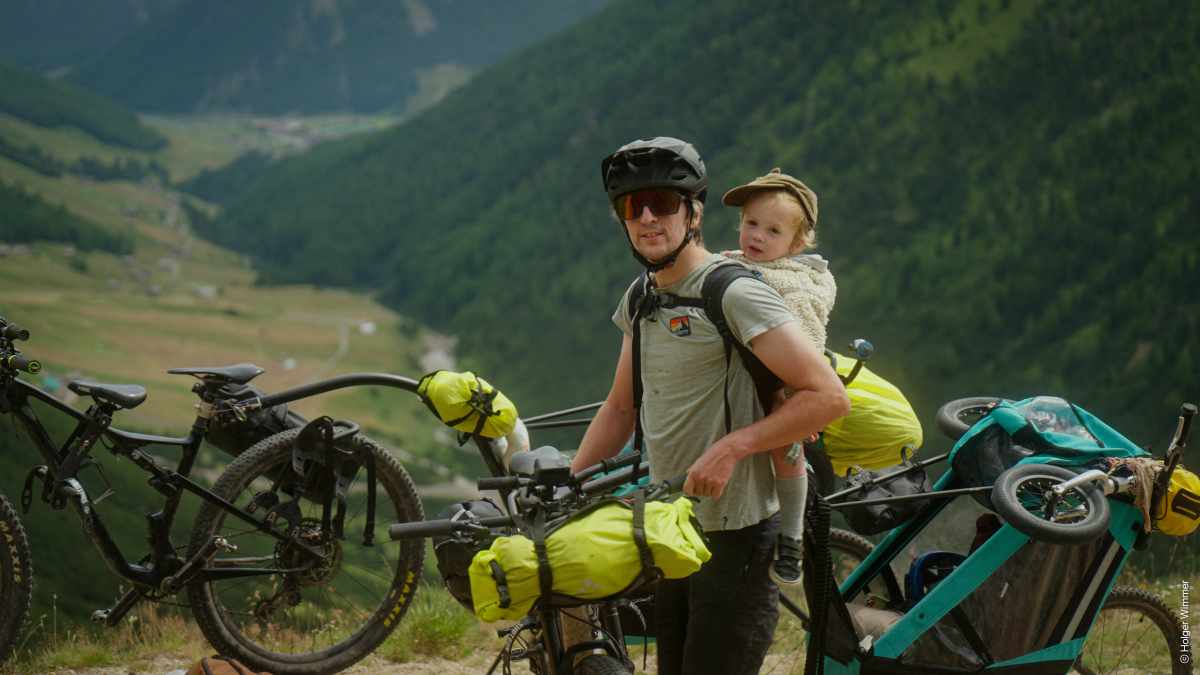
Finally, I would like to share a couple of exciting topics with you. One is a bikepacking tour by two fathers with their 2.5-year-old sons. I know many parts of the route and was amazed that the climbs were manageable with so much luggage and a trailer. Perhaps this will also inspire you to set off with a child yourself.
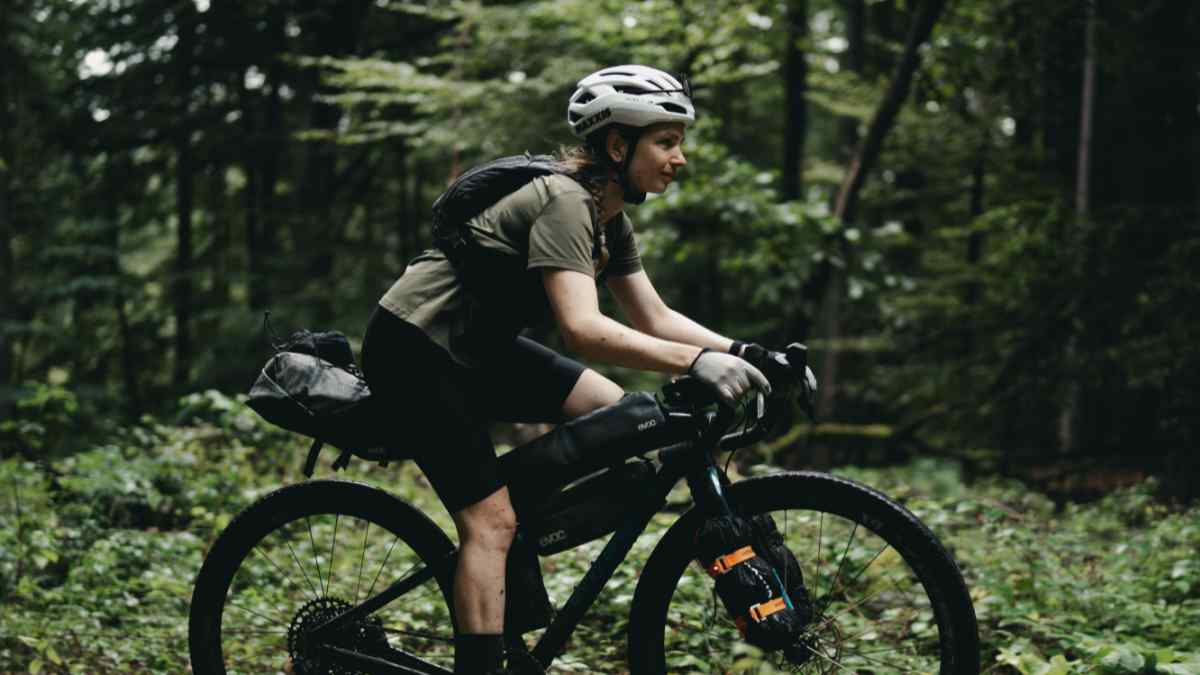
And how much luggage do you actually need on a bikepacking tour? Here are some important pointers:

Sandra Schuberth
Editor
