


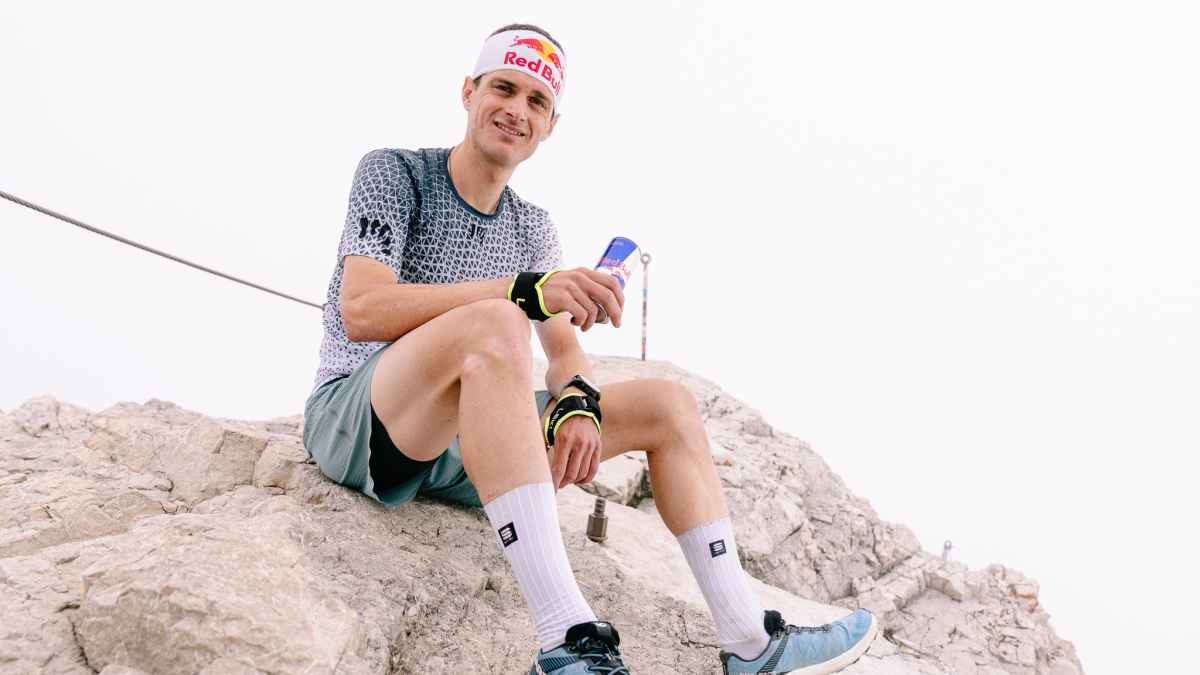
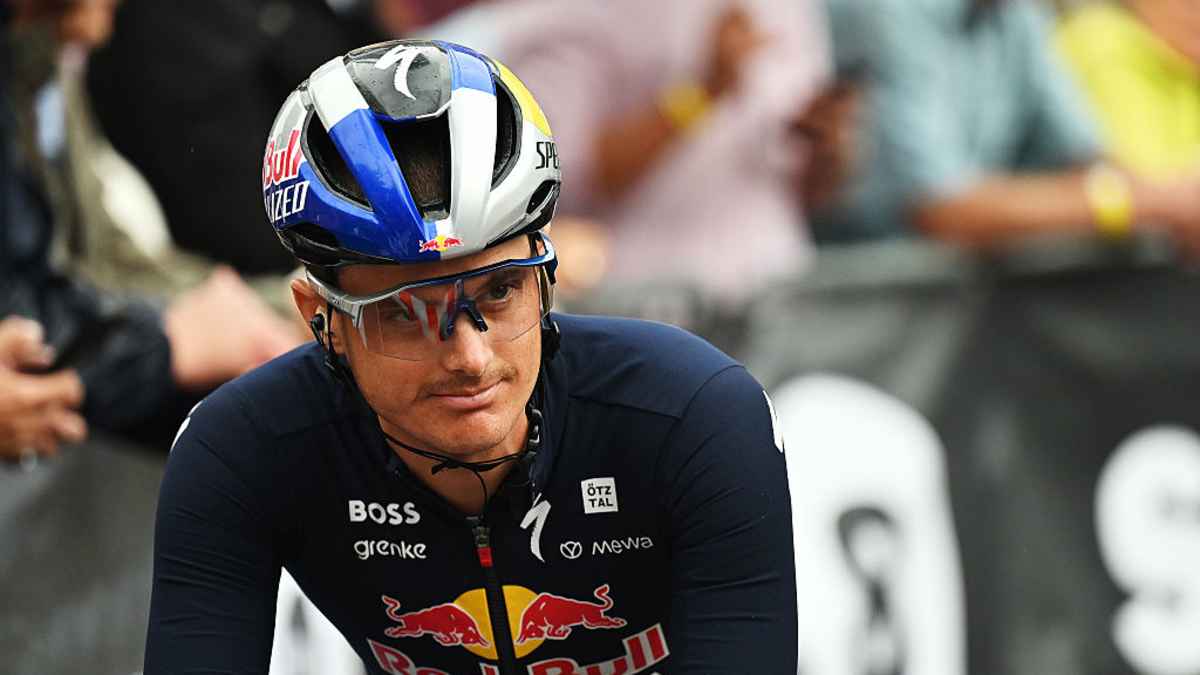
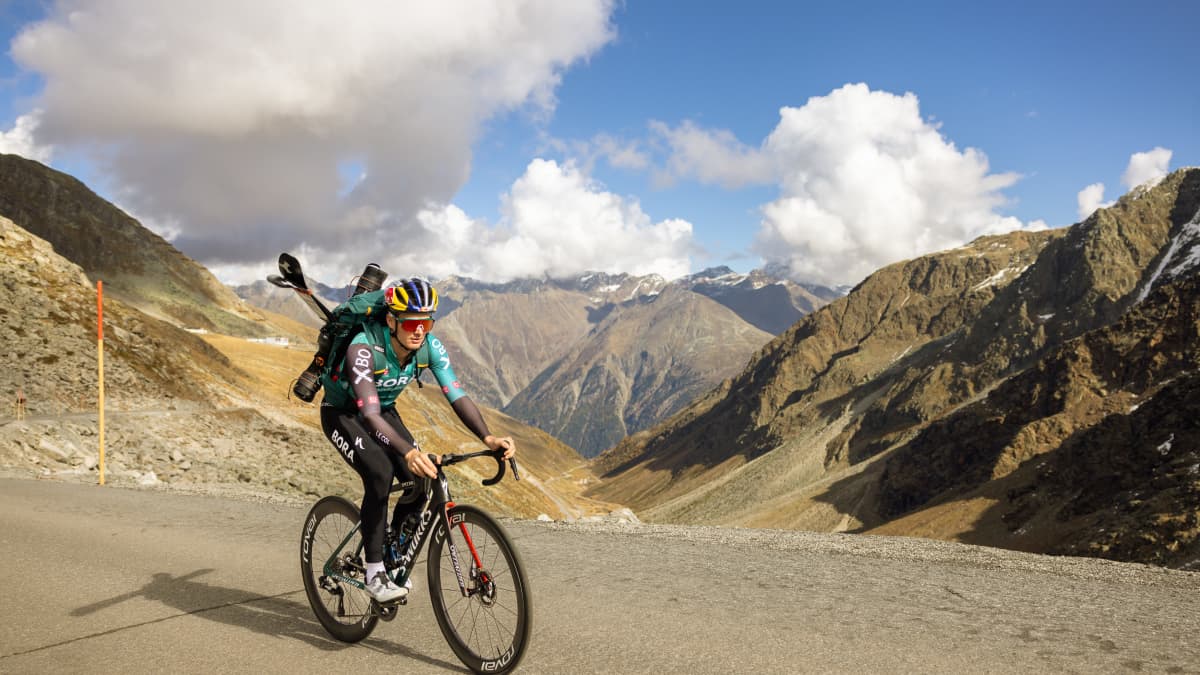
Ski mountaineer Anton “Toni” Palzer made the switch to cycling in 2021. Riding for Team Bora-hansgrohe/Red Bull, he competed in races including the Vuelta a España and the Giro d’Italia. By the end of 2025, his cycling adventure had come to an end. He tells TOUR just how gruelling his start in the WorldTour was and what his goals are for the 2026 Ötztaler Cycle Marathon.
An interview with Anton “Toni” Palzer. A look back at five years on the WorldTour and a look ahead to new goals: from the Ötztaler Cycle Marathon to the Olympic Games.
Anton Palzer: I was 28 when I became a professional cyclist. I had absolutely no experience of cycling. Getting started was like throwing a baby into the water: swim or sink. It was a brutally tough learning curve for me. If you’ve never ridden in a peloton and have to race alongside 160 complete madmen of roughly the same ability, it’s not easy. In certain situations, cycling is all about positioning. If you can’t make use of that because you’re simply afraid of being knocked off – I always told myself I mustn’t crash and hurt myself badly, because if I stop racing, I won’t learn. I think I did 55 races in my first season.

TOUR: In your first year as a professional, you took part in the Vuelta straight away and found it gruelling.
Anton Palzer: I didn’t want to ride the Vuelta back then; I tried everything I could to get out of it. I even rang Felix Großschartner – he was our team leader – and said, ‘Felix, I can’t help you with this.’ Felix is incredibly laid-back and said, ‘Toni, this is such a huge opportunity for you.’ You learn so much in those three weeks. I made it through, but I had a crash on the sixth day of the race. I don’t think there’s any other sport where you carry on racing whilst injured, but in cycling it’s quite common practice because cycling is a team sport. In skiing, if you’re in pain, you simply stop skiing.
TOUR: Word has it that you put on five kilograms during the Vuelta because you were under so much stress – is that true?
Anton Palzer: Yes, that’s right. I really did retain a lot of water in my body. When you’re under constant, sustained stress from riding in the peloton and fighting for position, it felt as though every single day I was riding at my absolute limit. I don’t think there’s ever been anyone who started cycling and then rode the Vuelta in the very same year. For me, it was such an extreme experience that I really started to have doubts about the whole cycling project. I simply didn’t have a shred of energy left. The team then pulled me out of the remaining races because my cortisol levels were so high.
TOUR: But things went very well the following year, didn’t they?
Anton Palzer: I was a completely different rider. I finished 25th in the Tour of Catalonia. Things went really well from then on. 2023 was probably my best year. I came 10th in the Tour of Turkey, rode brilliantly in Catalonia again, and that was why I rode the Giro d’Italia. They basically nominated me to the team at the last minute. That was the moment this year when I said to myself: OK, now I’m a proper professional cyclist. Now things are really taking off.
TOUR: What was the most important insight?
Anton Palzer: You’ve got to save your energy at the right moments. I’ll never forget what Christian Pömer, our sporting director, once said: ‘Toni, if you’re not right at the front, save every ounce of energy.’ It simply doesn’t do anyone any good if you’re flagging at the back and can no longer help your leaders. That’s so at odds with the sport I used to do, because I always gave it my all right up to the very last moment. You’ve got your captain, your leader, who’s demanding a result, and you don’t really care if you finish 20th – nobody’s interested in that.
TOUR: The biggest change for you was that, all of a sudden, you were part of a team.
Anton Palzer: My team really did an outstanding job – and not just the staff, i.e. the sporting directors or coaches, but the riders as well. They helped me so much. When I look back at what Lukas Pöstlberger and Patrick Konrad invested in me: they’d say, ‘Toni, you’ve got to ride like this, you’ve got to ride like that.’ They realised: Toni’s got the power, he gets up the hill really fast, but he just doesn’t have that understanding of cycling. They really took the time and explained everything to me from the very basics. Unfortunately, there’s no book called ‘How to Be a Pro Cyclist’ that you can read and then think, ‘OK, that’s how it all works.’ It’s all about learning by doing.
TOUR: When you look back, what were the best moments? What springs to mind straight away?
Anton Palzer: When I crossed the finish line together with Lukas Pöstlberger and Patrick Konrad on the final stage in Rome. Because those two have shaped my career in cycling; they were my mentors. Conny had a pretty nasty crash in the final sprint of the last stage. There was a pile-up and he was right in the thick of it. We checked that Conny was all right and then we crossed the finish line together. That’s when I thought to myself, this is absolutely brilliant: Crossing the finish line after a three-week tour with two really good friends and mentors. The other was the 2023 Tour of Turkey. Ben Zwiehoff finished second back then, Lippowitz was fourth and I was tenth, and we won the team classification. Bernie Eisel was the sporting director back then, and Bernie’s just a brilliant bloke. He knows what people need, and over those eight days he created such a great atmosphere throughout the whole team – you could really tell how committed everyone was. You must never forget the human side of sport, no matter what it’s about – and in cycling, there’s so much money at stake. When you create a great atmosphere, you see what you can achieve. I really loved that.
TOUR: Let’s move on from the best moments to the low points. The 2024/25 season was a real low point.
Anton Palzer: The lowest point was definitely the pericarditis. They never managed to establish where it came from. They said it might have been caused by a herpes virus or that it was the result of a tick bite. The doctors also said it’s quite possible that you might develop a brief infection which affects the heart when you exert yourself. But I was never ill; normally you get something like that when you do sport whilst unwell. I wasn’t ill; I’d spent four weeks doing altitude training, rode the Bretagne Classic in August 2024 and crashed out of it after 220 kilometres. I then went back into training for another 10 days and wanted to complete the final block – I was in great shape. Of course, I’d lost quite a bit of skin in the crash. It was one of those mass crashes – about 15 riders went down, and I was one of them. I was in brilliant shape, and then, from one day to the next, I simply had no power left and started retaining a massive amount of water again. My heart’s pumping capacity wasn’t good anymore, so I went to Red Bull’s Athlete Performance Centre, where they did an ECG and immediately said something was wrong – they needed an MRI. I had my MRI scan that very same day and found out I had pericarditis. That was the darkest moment, not just in my cycling career, but in my entire sporting career.
TOUR: Is it true that you couldn’t even climb the stairs anymore?
Anton Palzer: Yes, it was absolutely dreadful for me because nobody could tell me how long it would take. They said it could take half a year, it could take a year, but it might also mean I’d have to give up sport. That was the worst thing for me, because sport is my job, it’s my passion. I’d love to go hiking in the mountains with my children, and I’d love to go climbing with them, and I’d love to pass on to them exactly what my dad passed on to me. And when I heard that, I just thought to myself: OK, now you’ve gone too far. Now you’ve ruined everything. But I didn’t realise what I’d done. I didn’t do anything at all for three months. I didn’t climb any stairs; I took the lift. But then things took a turn for the better. After three months, that is.
TOUR: You were able to race again in the 2025 season, but a lot went wrong.
Anton Palzer: I rode the UAE Tour in early February and it went well. I rode Strade Bianche, where I had a double puncture. After that, I rode Tirreno-Adriatico, but on the third day they sent me home. You could tell then that my body wasn’t ready for the strain yet. I was ill an awful lot after that. I’d recovered, was fit, cycled well, got ill again, and that’s how it carried on throughout the entire 2025 season – and that was really, really gruelling. I spent four weeks at altitude training and was really fit again, but then I caught a stomach bug and was completely out of action for two weeks. That’s when I got the call from Ralph Denk saying he wouldn’t be renewing my contract. And it was quite funny, because I said to Ralph: ‘I understand. Actually, I’d have been surprised if he’d extended it any further.’ I said, ‘Look, Ralph, you simply didn’t get anything out of me last year – I was more of an invalid than anything else.’
TOUR: But I suppose it still brought you down quite a bit, because every now and then you realised just how fit you were?
Anton Palzer: A bit of both, I’d say. I mean, obviously, it’s a disappointment. I did have a chat with other teams afterwards, and I could have carried on racing. But I’m a terribly hard-nosed realist when it comes to myself. And for me, it was just: ‘OK, Toni, you’re 32 now, you’ve got five years on the WorldTour behind you. I’ve invested an absolute fortune – that big step forward wasn’t going to happen. That’s just a fact, and then there was the news that ski mountaineering was becoming an Olympic sport. I could now use the momentum I’d built up over the last few years in cycling to transfer that energy back to skiing. And for me, it was simply entirely realistic that I’d be competitive at the Olympics. And so I said: I’m stepping away from this; I’ve got off lightly. I’ve had some absolutely brilliant and wonderful moments: riding Grand Tours for one of the best World Tour teams! Thank you, cycling – I’m going back to my roots. I’m turning my gaze back to the mountains. I’m privileged to have something else I can do alongside cycling. I never completely gave up on the other things – I went skiing every winter and still put on my running shoes now and then. As Forrest Gump said: life is like a box of chocolates, you never know what’s coming next. Cycling is amazing and, in the world of endurance sport, it’s the greatest thing you can do, but there are just so many other things that give me a sense of fulfilment. That’s why it’s not a bad thing at all.
TOUR: You’re competing in the Ötztal Cycle Marathon and are currently training in the Ötztal valley: do you want to win?
Anton Palzer: I’m doing the Ötztaler, but it’s not as if I’m focusing everything on it. My long-term focus is on the winter, and I know that I simply can’t peak over two seasons (Editor’s note: ‘peak’ refers to peak performance). I simply peaked last winter, particularly in March, when I won the Tour du Rutor, one of the biggest races on the ski mountaineering circuit. And I’m just using that to ensure really high-quality training. I see it more as a brilliant training environment. There are just loads of good cyclists there, and that really pushes you on. But of course, I’ll be taking part in the Ötztaler, and after that I’ll be riding the Red Bull Dolomitenman on a mountain bike – that’ll be a new experience for me too. I’m really looking forward to it.
TOUR: What are your plans for the future?
Anton Palzer: If I somehow manage to make it to the Olympics by 2030, I’ll have been a professional athlete for 17 years. I absolutely love sport, which is why this is my dream job. I don’t want to be away for seven weeks at a time any more, because life has so many wonderful aspects to offer and I want to savour them all. I’m really grateful for the opportunity I’ve been given. But I also think that Ralph (Editor’s note: Red Bull team manager Ralph Denk) must be grateful for what I’ve done for him.
TOUR: So is your long-term plan now to compete in the 2030 Olympic Games in ski mountaineering?
Anton Palzer: Exactly. I’m not joining the World Cup now, and probably not the winter after next either. I don’t want to work with federations again or be part of that sort of structure, but goals are extremely important to me. That’s why I get up early and go for a train, and why I make sure I lead a healthy lifestyle. I think it’s realistic that I’ll be competitive at the 2030 Olympics in France. I mean, that’s still three and a half years away – that’s a long time, and an awful lot can happen in that time.
TOUR: But you certainly don’t earn as much money from ski mountaineering as you do on the WorldTour
Anton Palzer: No, definitely not. I’ve already saved up a bit over the last few years. Money should never be the driving force. I say: as long as I can pay my bills, do my sport properly and my future family is well looked after, everything’s fine. I don’t need a fancy watch on my wrist. That’s how I grew up. My dad’s a mountain guide, my mum’s a dental assistant, and we run a small guesthouse. But, that’s up to each person to decide.
TOUR: Do you still have any sporting dreams or projects?
Anton Palzer: So, what I’d absolutely love to have a go at is trail running – races like the 40–50-kilometre Marathon du Mont Blanc or the Sierra-Zinal; that would certainly appeal to me. But I’d need to train for it, of course. As I’m currently spending 30 hours a week on my bike, it’s just not possible. But it’s definitely something I’d like to give a go next year or the year after.

Kristian Bauer
Editor