


Gravel bike buying guide: Don’t buy one until you can answer these questions!
Laurin Lehner
· 31.08.2026


Hardly any other category of bike is growing as rapidly as the gravel bike. At the same time, more and more people from other disciplines are taking it up – people who previously had little or no experience of cycling. That is precisely why guidance is needed – and not just for beginners. Even seasoned mountain bikers or road cyclists can quickly lose track of things with so many product categories to choose from. So what exactly is the difference between a gravel bike designed for adventure and a model intended for racing or everyday use in the city?
A quick guide in 7 steps
Here are the key points in a nutshell.
1. How much money do I want to spend?
It’s the classic question you’d hear from a car salesman. Just as with any major purchase, you should ask yourself this when buying a gravel bike. If you’ve no idea how much a proper gravel bike costs, let me tell you: it doesn’t have to cost more than 3,000 euros. Of course, there’s no upper limit. Particularly lightweight models offer excellent forward momentum – but they’re also expensive. For every 250-gram reduction in weight, you’ll have to dig deep into your pockets.

2. How important is the brand to me?
Brand loyalty should not be underestimated. Which brands do I associate with a cool image? It’s even better, however, if you’re not tied to any particular brand – because then you can make real savings without having to compromise on performance. Mail-order brands such as Radon, Axcess and the like offer excellent value for money, whilst with many sought-after brands such as Specialized and the like, you’re simply paying part of the price for the name alone.
3. What can I do without in order to save money?
First things first: your gravel bike shouldn’t weigh much more than 10 kilos. Why? Click here to read the relevant article: >> The question: How heavy can a gravel bike be? <<
Anything under 8.5 kilos tends to be expensive. If you want to save money, you’re better off going for models weighing around 9 to 9.5 kilos – that’s the sweet spot. Electronic gear systems are all the rage and certainly have their advantages (but also their disadvantages). If you want to save money, it’s best to do without them – as this feature really adds to the price.
4. Do I like the cockpit?
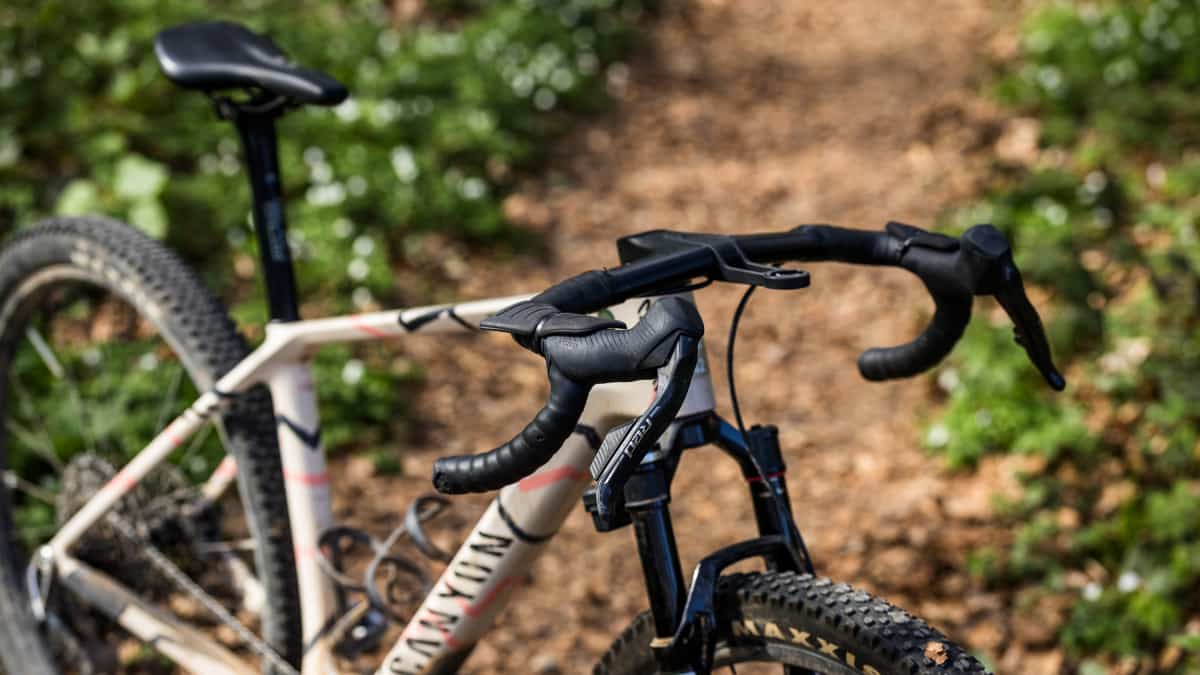
The cockpit is the control centre – and a very personal choice. In short: you should like it. Drops, flare, narrow, wide – preferences vary greatly here. That’s exactly why you shouldn’t compromise on this. Of course, you can get used to a cockpit that doesn’t feel quite right at first. Nevertheless, you should want to reach for it.

5. Should I buy from the manufacturer or a specialist retailer?
It’s a real dilemma. Of course, there are some great deals to be had at the dealer – and you get personalised advice on top of that. And if something does break, you can simply roll your bike into the shop without feeling guilty about it.
On the other hand, online retailers also provide good advice if you still have any questions – and service partners take care of your bike when it needs servicing or repairs. In short: with a few exceptions (e.g. Cube), online retailers offer the best deals. With specialist retailer brands, you get brand image and a greater sense of exclusivity in return.

6. Open countryside or a forest track?
Much like Question 1, this one is also essential. After all, to find the right bike, you need to know what you want to use it for. Anyone planning to tackle steep climbs should probably opt for a double chainring setup. If you tend to ride on gentler routes and want maximum propulsion, you’re better off prioritising fast tyres. And if you want to open it up off-road too, you should opt for thick, comfortable tyres and a wide handlebar and stem.

7. Speed gravel or XXL tour?
Do you want to go all out on forest tracks and gravel with Vmax after work or at the weekend – or, above all, go on tours with bikepacking panniers and use it to commute to work? If you’re looking for a comfortable bike suitable for touring, you don’t need to worry too much about the weight. Bikes weighing around 10 kilos are a good fit here. A nice bonus: they’re usually cheaper too. Most bikes come with mounting points for a second bottle cage and the like anyway. A slightly wider tyre makes sense here too – more volume means greater comfort thanks to better shock absorption.
On the other hand, if you see your gravel bike more as a racing machine and would prefer to ride a road bike – just on gravel – you’ll be looking for a lightweight frame, thin, fast tyres and a narrow, aerodynamic cockpit. These bikes are known as speed gravel bikes.


Laurin Lehner
Editor