


Tour de France 2026: The 113th edition of the cycling classic
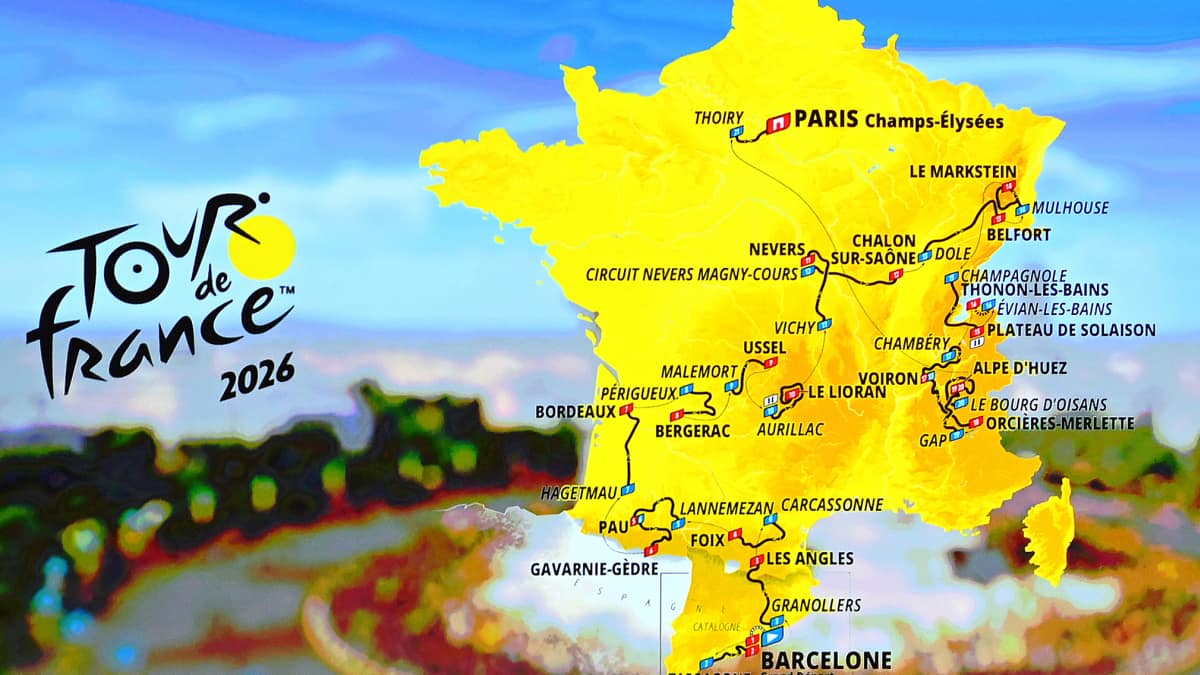
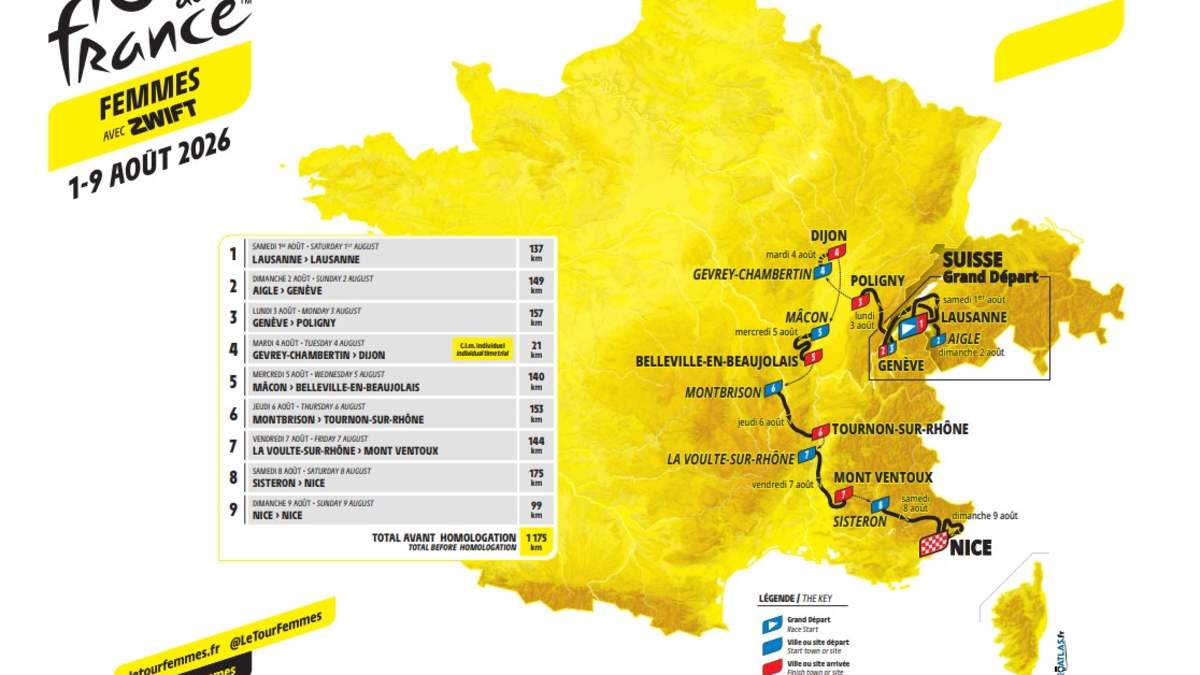
The 113th edition of the Grand Départ will take place in Barcelona in 2026, starting with a team time trial on Saturday. The Tour de France Femmes avec Zwift enters its fifth round. The 2026 start is in Lausanne Here is the most important information at a glance:
Tour de France: The battle for the yellow jersey
The Tour de France is the most famous cycle race in the world. Past the most beautiful spots France's takes them across the country - from the harsh north to the warm south. The riders conquer massive peaks in the Alps and the Pyrenees before the Tour traditionally ends with the finish on the Champs-Élysées in the centre of Paris. TOUR gives you an overview of the Tour of France and provides you with the most important news and results from the Tour de France.
Tour de France: The most important road race in the world

The Tour de France is the most famous cycling race in the world and, along with the Olympic Games and the Football World Cup, is one of the biggest sporting events of all. Together with the Giro d'Italia and the Vuelta a España it forms the Grand Tours - the most important road cycling races of our time.
The Tour de France has been taking place every year in July for over 100 years, since 1903 to be precise. During the Grande Boucle (French for Grand Loop), the riders cross the whole of France on alternating routes - but also make detours to neighbouring countries such as Belgium, Spain or the Switzerland. It is not uncommon for the start of the tour to take place in neighbouring countries, such as the UK, Monaco, the Basque Country in 2023 or Florence in Italy in 2024.
As a rule, 22 Professional teams The Tour de France has long consisted of nine riders, but for some time now only eight. In 2024, after a Decision of the UCI However, there will be 23 teams. According to the regulations of the International Cycling Union (UCI), the 18 UCI World Tour teams (the best professional teams in road cycling) always have the right to participate in the Tour, while the organiser invites other so-called pro teams for the remaining starting places.
The teams come from a wide variety of countries: Teams from France, Spain, Belgium, Germany, Bahrain and the United Arab Emirates compete in the Tour of France. The nationality of the team has nothing to do with the nationality of the individual professional cyclists - unlike in the football World Cup, for example. For example, some riders come from South America or Australia.
The route: climbing and sprinting in the hexagon
The Tour de France is characterised by varied stages between the flat plains of Normandy, the massive peaks of the Alps and the challenging topography of the Côte d'Azur. During the Tour, the riders cross more than a third of the French departments as well as areas in neighbouring countries. The 22 teams in the French hexagon will cover around 3500 kilometres in 23 days and 21 stages. The individual stages are divided into flat stages, hilly sections and mountain stages with various mountain top finishes and time trials.
The exact route of the Tour of France changes every year - even the direction changes: If the riders complete the tour from a south-westerly direction and anti-clockwise, they first cross the Pyrenees and then the Alps. The following year, they often ride the other way round, first to the east and then clockwise to the south.

Le Grand Départ: The start of the national tour
The start of the Tour is traditionally known as Le Grand Départ (French for the grand descent). While the tour also started during the week, especially in the early decades, it now usually starts on the first Saturday in July.
Until the 1950s, the start and finish of the Tour of France were almost always in Paris. Since then, the Grand Départ has also been held in other parts of France and abroad, while the capital continues to mark the finish of the Tour. One exception was in 2024. Nice served as the finish line there, as the Olympics were being organised in Paris.
In the years 1967 to 2012, the cycling race usually started with a prologue - a time trial that served to introduce the riders to the public. This is no longer the norm, as the riders usually start the Tour de France with a regular stage of around 180 kilometres.
Varied stages: Highlights in the Alps
For many spectators, the mountain stages are the most exciting sections of the Tour - especially because they are the most fiercely contested. The climbers in France can prove themselves on several mountains at once: Depending on the edition, the tour leads through the Vosges Mountainsthe Alps, the Massif Central and the Pyrenees.
The particularly demanding climbs of the Tour of France are preferably scheduled for the second and third weekends of the Tour and the French bank holidays on 14 July. In this way, the organisers hope to attract a particularly large number of spectators, also along the route. The two mountain passes, for example, are among the most famous climbs of the Tour de France that the riders wind their way up Col du Galibier and Col du Tourmalet or the Mont Ventoux.
In the climbing stages in the Alps and Pyrenees, the riders often have to overcome more than 3000-4000 metres of altitude in just one stage. Gradients of between 8 and 15 per cent are quite normal, and sometimes the athletes even have to contend with gradients of up to 20 per cent in short sections of the race.
In general, the Tour de France with many challenges In some years, the riders have to tackle almost 20 kilometres of cobblestones. Due to the challenging surface for the thin tyres of the racing bikes, this is a real spectacle, especially for the spectators!
But even the usual flat stages can be quite challenging for the riders: In the coastal region of France, there can be so-called wind-edge passages, which often decide the stage victory. These sections are characterised by a strong crosswind, which Many teams use a wind edge formation to their advantage want.
The riders try to position themselves laterally offset in the slipstream of the rider in front of them, creating a diagonal row of riders on the road. Due to the lack of space and with the right tactics, the head group has the opportunity to wear down competing teams that fall out of the group so that they lose touch.
The final stage: traditional finish on the French boulevard
Since 1967, the final stage of the Tour de France has always taken place on a Sunday. In road cycling, it is an unwritten law that the leader of the overall standings is not attacked on the final stage in order to give him a glorious reception in Paris. The final stage is therefore also known as the Tour d'Honneur (French for Tour of Honour). However, not all riders have adhered to this code of honour in the past, resulting in neck-and-neck races on the Parisian boulevard. Here too, 2024 was a special case, as the Tour ended with an individual time trial and there was therefore no Tour d'Honneur. As in 2025, this could also be the case this year, as the Montmartre the organisers have come up with something special for the final day.
Regulations and rankings: What is there to win at the Tour de France?
The Tour de France is not just about the yellow jersey: the green, white and polka dot jerseys are also highly coveted. The International Cycling Union (UCI) determines the classifications for these. For example, if a rider leads several classifications at the same time, the second-placed rider moves up and wears the jersey as a substitute. Which jersey the leader wears depends on the following prioritisation: yellow before green before dotted before white.
Not all of the almost 180 riders who start the Tour with the Grand Départ finish in Paris. Some cyclists drop out due to injury or illness, while others are disqualified or fall outside the time limit. This means that the riders must finish a certain distance behind the winner, otherwise the Tour de France is over for them. This grace period depends on the difficulty of the stage in question and the time of the stage winner.

Yellow jersey (Maillot Jaune)
The yellow jersey is worn by the rider who leads the overall standings - or, to be more precise, has the lowest total time required. This is calculated by adding together the times of the individual stages. This also takes into account the time bonuses that the top 3 of a stage and the bonus classifications receive.
It can happen that an athlete wins the Tour without winning a stage - for example Chris Froome in 2017. The yellow colour of the jersey goes back to the sports newspaper L'Auto, which founded the Tour in 1903. It printed its newspaper on yellow pages - so the jersey is a reference to the history of its origins.
Green jersey (Maillot Vert)
The green jersey is worn by the best points collector. Points for this classification are awarded to the 15 riders who cross the finish line of a stage first or win a sprint classification. The flatter a stage is, the higher the respective classification. In the event of an equal number of points, the number of stage wins and intermediate sprints won will determine the winner of the green jersey.
Dotted jersey (Maillot à Pois)
The mountain jersey is a white jersey with red dots, which is awarded to the leader in the mountain classification. There are five different categories into which the mountains of the Tour de France are categorised according to their gradient and length. The more difficult and gruelling the climb, the more classification points are awarded to the first 10 to 15 riders to cross the passes and mountain finishes. The most difficult climbs are categorised as HC (hors categorie), followed by 1st, 2nd, 3rd and 4th categories
White jersey (Maillot Blanc)
The white jersey is awarded to the best young professional. As with the yellow jersey, the total riding time of all riders under the age of 25 counts.
There is also the team classification and the yellow and red start numbers, which are awarded to the athletes and teams. These honours are awarded to the riders of the best team and the most aggressive rider respectively.
Tour de France: Who are the past winners?
Since the Tour of France began, four cyclists have each won the overall classification five times: The Frenchman Jacques Anquetil (1957, 1961-1964), the Belgian Eddy Merckx (1969-1972, 1974), the Frenchman Bernard Hinault (1978, 1979, 1981, 1982, 1985) and the Spaniard Miguel Indurain (1991-1995). Britain's Chris Froome, who is still actively involved in cycling, rode to the finish in Paris with the yellow jersey in 2013 and from 2015 to 2017.
The US American Lance Armstrong even won the Tour seven times. However, he was stripped of all his Tour de France victories in 2012 because he was subsequently disqualified from the race for doping. The titles were not re-awarded.
Britain's Mark Cavendish has the most stage wins to his name. He was the first to cross the finish line of a stage a total of 35 times. With his 35th success, Cavendish surpassed Merckx in 2024, who has 34 stage wins.
The winners of the Tour de France over the last twelve years
- 2025 Tadej Pogačar (Slovenia)
- 2024 Tadej Pogačar (Slovenia)
- 2023 Jonas Vingegaard (Denmark)
- 2022 Jonas Vingegaard (Denmark)
- 2021 Tadej Pogačar (Slovenia)
- 2020 Tadej Pogačar (Slovenia)
- 2019 Egan Bernal (Colombia)
- 2018 Geraint Thomas (Great Britain)
- 2017 Christopher Froome (Great Britain)
- 2016 Christopher Froome (Great Britain)
- 2015 Christopher Froome (Great Britain)
- 2014 Vincenzo Nibali (Italy)
The winners of the Tour de France Femmes
- 2025 Pauline Ferrand-Prévot (France)
- 2024 Katarzyna Niewiadoma (Poland)
- 2023 Demi Vollering (Netherlands)
- 2022 Annemiek van Vleuten (Netherlands)
The history of the Tour of France
The Tour de France was launched in 1903 by the sports newspaper L'Auto as the first stage race in cycling. The newspaper's aim was to increase its circulation - especially in view of the figures for its rival paper Le Velo, from which L'Auto had split in 1900. And it was a success: Le Vélo was published for the last time in 1904.
Henri Desgrange was the editor-in-chief of L'Auto until his death in 1940 and thus also the Tour director. He also introduced the yellow jersey in 1919 and the mountain classification in 1933. After L'Auto was banned following the liberation of France in 1944, the successor title L'Equipe was published two years later, which is still one of the most widely read daily newspapers in France today.
The Amaury Sport Organisation (ASO) has been the organiser of the Tour de France since 1992. Since 2011, the Tour de France has been part of the UCI World Tour, the series of major one-day and stage races organised by the International Cycling Union. It is the successor to the UCI Pro Tour.
60 riders took part in the first Tour de France, which began on 1 July 1903. The Tour of France started in Montgeron near Paris and ran over a total of six stages. The riders covered a total of 2428 kilometres in the race, with Frenchman Maurice Garin crossing the finish line first. The prize money for winning the first Tour was 6075 francs (the equivalent of 926.13 euros today).
Since then, the tour has been held every July. Only during the First and Second World Wars, i.e. from 1915 to 1918 and 1940 to 1946, was there no Tour. The Tour of France was also organised differently during the COVID-19 pandemic: in 2020, it did not take place in July, but in August and September. In order to minimise the risk of infection during the Tour in late summer, the participating teams were also separated into so-called "bubbles", which were only allowed to meet during the race. In addition, there was a virtual tour with a separate classification consisting of six stages.
With a few interruptions, a Tour de France for women also took place from 1984 to 2009 - the Grande Boucle Feminine. For 2026, the fifth edition of the Tour de France Femmes planned. It comprises nine stages.


