


Travelling through Switzerland: From Lindau to Montreux in five days by road bike
Jörg Wenzel
· 12.03.2024


Can that be true: 18 per cent? Axel looks at me questioningly. "That's a good start!" grumbles my buddy and gets out of the saddle and into the cradle. I try to calm him down: "The road sign can't be right. I've been here before and for the life of me I can't remember 18 per cent." Yes, I know the eastern flank of the 1,548 metre high Pragel Pass. It is steep. But not that steep. The steepest metres are probably 16 per cent - if you cut the hairpin bends on the inside. In any case, the finely tarmaced road from the western end of the Klöntalersee, where the 18 per cent sign is, winds its way moderately upwards at first. At the bottom, we climb past farmhouses before plunging into the forest, where pastures open up to reveal views of the nearby mountains.
Swiss diminutive forms
We pass a bus stop sign, next to which is a bench roughly hewn from a tree trunk. It says "Mitfahrbänkli", which is a kind of organised car stop for pedestrians who want a lift from cars. The Swiss seem to like this diminutive: "Bänkli" - or "Knusperfischli", which I had on my plate the previous evening at my accommodation on Lake Klöntaler. The narrow, winding roads to the Pragelpass - or via Schwägalp and Vorder Höhi, which we travelled yesterday - also look cute. However, it would be completely inappropriate to add a "li" for "Pässli" to them ...

Two days ago, Axel and I set off on a warm, summery September day from the harbour in Lindau, an island in the eastern tip of Lake Constance, just inside Germany, a few kilometres from Austria and Switzerland. From there, we set off for Lake Geneva, in the south-west corner of Switzerland. Our route winds playfully through the foothills of the Alps, dipping more or less into the mountains and climbing over passes whose names are probably only familiar to a few.
Through the Swiss doll's house
On the first day, we don't drive over mountain passes, but through the hills of Appenzellerland. Small, lonely roads lead high above the Rhine Valley into a quiet farming country of cow pastures and farms, whose wood-shingled houses are sometimes painted light blue, sometimes grey, red or pink. The whole thing gives the impression of a doll's house, and the villages perched on hilltops or seeking shelter beneath them look from afar as if a child had scattered building blocks across the land. Just like the houses in the settlements, the inns are scattered across the Appenzellerland. We park our bikes against the wall of one of them. We are sitting in the small, brightly panelled Gasthaus Schäfli in Trogen. Landlord Ueli Künzle, who looks like the Alpöhi from the Heidi film with his grey hair and beard, serves us homemade apple and apricot cake, accompanied by coffee from the portafilter machine.
Künzle, we learn, is actually a trained chemical laboratory technician, but has been earning his living as an organic farmer since 1974 and has also been running the Schäfli farm with his wife for a few years. We say goodbye to tackle the last few kilometres to the village of Appenzell. Shortly before our destination for the day, the Alpstein massif with the Säntis peak, the highest mountain in the Appenzell Alps at 2,502 metres, appears on the horizon to the south. This is where we want to climb up to Schwägalp tomorrow ...

In the morning, we start in the middle of Appenzell at the beautiful Landsgemeindeplatz, where the houses have colourfully painted wooden façades. This is a historically important square, where every last Sunday in April the people of Innerrhoden who are entitled to vote gather for the Landsgemeinde and vote on constitutional, legislative and credit proposals. For a long time, the Landsgemeinde was a purely male affair; women were first allowed to take part in 1991. Women's suffrage only in 1991 - such thoughts run through my mind as we approach the Säntis and turn off onto a narrow road closed to motorised traffic, which curves over several Alps to Schwägalp.
The little road is peppered with up to 14 per cent steep ramps, but mostly climbs between 9 and 12 per cent uphill under the mighty wall of the Säntis summit crowned with transmission masts. On the lower Alps, the bells of a few cows in the pasture are still jingling, further up it becomes so quiet that I can only hear our breathing. Shortly before the little road passes the valley station of the Säntis suspension railway, it almost touches the mighty north face. Room-sized boulders scattered at its foot bear witness to the fact that monsters have broken loose from it from time to time. The last rockfall occurred in 2020. Today, everything remains calm.

Vorder Höhi: Tough, but hardly known
The next ascent to the 1,534 metre high Vorder Höhi is also quiet and lonely, covering around 650 metres in altitude. Like the alpine road to Schwägalp, this is also closed to motorised traffic, but is even steeper with longer 16 per cent ramps - and more wooded. View: zero. This makes the climb even harder because there is nothing to distract you from the effort. What's more, the tarmac soon gives way to concrete slabs. "Bodum ... bodum ... bodum" - the cross grooves are annoying. Only at an altitude of around 1,450 metres does the forest recede. The sunny alpine meadows and the view of the Churfirsten peaks act like an energy drink. While the climbing in the forest was still tough, I flutter the last few metres up to the pass like a butterfly among the mountain herbs. At the top, on the Vorder Höhi, I wait for Axel, who had fallen behind in the forest. We have a drink and enjoy the view. "I'm just too heavy for such long, steep climbs," says Axel, "but the view up here is great! Look, over there is the Säntis, that's where we came from."

However, our route not only shines with lonely climbs, magnificent views and winding descents, on the third day we have also included a cosy lake cruise. At lunchtime, we sit on the upper deck of the car ferry, which takes us from the north to the south shore of Lake Lucerne in 20 minutes, and let the sun warm us up. On the southern shore, however, we have to hurry, storm clouds are already shooting towards the stratosphere and we know that there is still a big challenge ahead of our destination in Sörenberg: the longest climb of our journey, the pass over the 1,611 metre-high Glaubenbielen.

At its foot is a sign: "Climbs 1,120 m over 12 km", an average of just under ten per cent - hardly any of the more famous major Alpine passes are this steep. After a few minutes, I'm dripping with sweat on my handlebars and top tube in the humid, thundery air. Axel, who is cranking strictly according to his heart rate monitor, falls behind. Soon I'm alone on the mountain - I rarely come across cars either - and greedily suck the last sips from the bottle. I should have topped it up again down in the village! Should have, should have ... But like the days before, it's no problem to get water. Halfway up the climb, a fountain comes to my rescue. I pour the cold water down my neck, have a drink and cycle on. Shortly before the top of the pass, I feel the first drops of rain on my face.
I wait for Axel at a small car park with a view of the mountains and Lake Sarnen. Although grey clouds cover the pass, it remains a drizzle. Then Axel arrives, calmly and with a steady stride, and with him the rain. We fly the last, no longer so steep metres to the pass, which has nothing to decorate or spoil it: no car park, no hut, no kiosk. Just a sign with the name and altitude on the side of the road. After a seven-kilometre descent, during which it pours with rain, we are glad that a hot shower and dinner are waiting for us in Sörenberg.
Water torture in the spray tail
A thunderstorm also hits us on the fourth day, but as before only in the afternoon. After Thun, we turn south into the mountains, whose peaks are already covered in dark clouds, and onto National Cycle Route 9 in the Simmental. The narrow road winds through pastures grazed by Simmental Simmental cattle, the local breed with reddish-brown to light yellow coats and white patches. The ringing of its bells is like a meditation that harmonises landscape and cyclist. From time to time, pretty farmhouses line our route, bearing witness to the prosperity of earlier centuries. One of them, a cathedral of craftsmanship, is so magnificently carved and painted that we can't help but dismount and marvel. The Knuttihaus in Därstetten, built in 1756, is considered the most beautiful house in the Simmental and is probably one of the most magnificent in the canton of Bern.

Shortly afterwards, a rough gravel surface forces us to swerve onto the main road. A downpour sets in. We take refuge under the canopy of a bakery, which is located in a secluded spot between two villages on the road, and dig our rain gear out of our bags. After a coffee, we resign ourselves to the inevitable. We crank bluntly through the deluge, in which overtaking cars and lorries torture us with their spray tails. We skip the turn-off to the Jaun Pass. The beautiful, longer and more than 800 metres higher option over the 1,508-metre-high pass and the even more beautiful, lonely Mittelberg (1,633 metres) to Saanen makes no sense in this terrible weather. Now it's time to arrive!
Steep ramp before the Saanenmöser Pass
In Zweisimmen we can follow cycle path 9 again, which immediately turns into a long, 16 per cent steep ramp. On the climb, my front wheel almost crushes a snail dragging its shell across the road through the rain. We don't feel like we're crawling much faster. Shortly before Saanenmöser, the transition to Saanen, we even have to dismount. We can't manage the 24 per cent ramp with our luggage. We push, how humiliating! But the feeling of humiliation is forgotten as we hurtle down to Saanen, and even more so when we end the day with Simmental beef and cheese fondue.
The next morning, only remnants of the storm still cling to the mountains. We turn back onto cycle route 9, which takes us away from the traffic through the valley of the Saane, soon to be called "La Sarine" as we pass the border with the French-speaking part of Switzerland. The meadows we pass through lie in the valley like humpback whales cutting through the sea, and the flanking mountains rise up just as humpbacked, with the morning sun glinting off them. After twelve tranquil kilometres, we reach the road to the Col des Mosses (1,445 metres). Apart from the Pissot Gorge at the start, it offers little in the way of spectacle, as I knew from previous journeys and had therefore planned the remote and beautiful diversions via the Hongrin reservoir. Unfortunately, I hadn't realised that the road leading over the military firing range "Petit Hongrin" is closed on weekdays in September. Nothing to be done, the military post at the lowered barrier won't let us pass. Somewhat frustrated, we climb over the Col des Mosses, rush 18 kilometres down into the Rhone Valley and a little later reach Lake Geneva, which lies there as smooth as glass, framed by hills like a diamond in a frame. The end of our tour by the lake reminds me of the start four and a half days ago. Only four and a half? It must have been a lot more ...

Information about travelling through Switzerland
Arrival and departure
Train journeyt
In four to four and a half hours, for example, from Frankfurt am Main to Lindau-Reutin (mainland). To take your bike on the ICE to Ulm, you need a bike ticket including a parking space reservation for 9 euros, which is also valid for the onward journey on the Interregio-Express (IRE). If you prefer, you can change in Reutin to the Austrian Regional Express (REX), which takes you to the island in four minutes - you can get there just as quickly by bike from Reutin. Info: bahn.de
Return journey by train
From Montreux to Frankfurt am Main in five and a half hours. First take the Interregio (IR) to Lausanne, then change to the IR to Bern (information at www.sbb.ch). In Bern, continue with the ICE. For the two IR trains, which do not require a reservation, you need a day bike ticket for 15 Swiss francs; for the ICE, as on the outward journey, you need a long-distance bike ticket for 9 euros.
Best time to travel
May to October. There is more holiday traffic in July and August, but this is not so noticeable on many of the secondary routes we have chosen. From October onwards, when you can still experience beautiful days if you're lucky, winter can set in at altitude - and if you still want to cross the Jaunpass and Mittelberg on day 4, you shouldn't dawdle on short autumn days with 133 kilometres and 2,430 metres of altitude difference.
Accommodation
Day 1, Appenzell: Hotel Löwen, telephone 0041/(0)71/7888787, loewen-appenzell.ch
Situated in the centre, with beautifully renovated rooms. A fine buffet is laid out in the morning in the elegant breakfast room. Two people pay from 180, usually 220 Swiss francs for a double room with breakfast.
Day 2, Klöntalersee: Hotel Rhodannenberg, telephone 0041/(0)55/6501600, rhodannenberg.ch
Magnificently situated at the eastern tip of the Klöntalersee. Renovated rooms, home-style, delicious cuisine. Two people pay from 175 Swiss francs for a double room with breakfast.
Day 3, Sörenberg: Hotel Sörenberg, telephone 0041/41/4881361, hotel-soerenberg.ch
Simple but cosy, located directly on the (quiet at night) main street. Double room with breakfast from 173 Swiss francs. We ate across the street at Alpenrösli (www.restaurant-alpenroesli.ch): meat-heavy, but they also serve trout or Älplermagronen.
Day 4, Saanen: Gstaad Saanenland Youth Hostel, telephone 0041/(0)33/7441343, youthhostel.ch
The modern building made of wood and concrete is just a few minutes' walk from the village centre. An overnight stay including breakfast costs from 48 Swiss francs per person in a shared room and 124 Swiss francs in a double room.
Food & Drink
Swiss cuisine combines influences from Germany, France and northern Italy. Although it varies greatly from region to region, some dishes are popular throughout Switzerland. These include raclette, melted cheese served with "Gschwellti" (jacket potatoes), gherkins and onions; Älplermagronen, a kind of gratin made from potatoes, macaroni, cheese, cream and onions, served with apple sauce - and Rösti, a flat cake made from grated cooked or raw potatoes and fried in hot butter or fat in a pan. And as our cycle route leads to many lakes, fish such as whitefish, perch or trout are also on the menu.
Swiss cheese is also a must-try! Following the sequence of our route, first the soft-cut Appenzeller, then the hard, flavoursome Sbrinz from Central Switzerland, then the holey Emmental, whose administrative district we briefly pass through on the fourth day, and finally the world-famous Gruyère, whose production can be traced back to the year 1115 in the Gruyère region.
However, there is one downside to eating out in Switzerland: it's expensive. If you go out to eat, you have to spend around twice as much as in Germany.
Restaurant tips
- Appenzell (Day 1): Romantic Hotel Säntis, telephone 0041/717881111, saentis-appenzell.ch
The wood-panelled, elegant restaurant on Appenzell's Landsgemeindeplatz serves seasonal Swiss cuisine of a high standard at reasonable prices. - Thun (Day 4): Ristorante Primavera, telephone 0041/332222420, primavera-thun.ch
In the centre of Thun, directly on the River Aare, you can top up your energy stores halfway through the stage (61.8 km) with delicious wood-fired pizzas - at moderate prices. - Saanen (Day 4): Restaurant Landhaus, telephone 0041/33/7484040, landhaus-saanen.ch
Head chef Christian Zoss blends his many years of experience from Mexico with Swiss cuisine, the latter including Simmental beef fillet, barley soup, rösti with cheese and fried egg and, of course, cheese fondue.
Don't miss it!
Day 2, Schwägalp show dairy: From May to September, around 55 farmers deliver alpine milk to the cheese dairy at the foot of the Säntis. However, no Appenzeller is "cheesed" in the small show dairy; the majority of the milk is processed into fine Schwägalp cheese, which tastes just as delicious. The rest is used to make raclette cheese, butter, Mutschli and goat's cheese. Tip: You should avoid the summer excursion weekends for a visit to the Schwägalp. Information at alpschaukaeserei.ch
Day 4, Thun Castle: The mighty donjon (residential and defence tower) built by the dukes of Zähringen around 1200 with its magnificent high medieval knights' hall can be visited. From the towers you have an impressive view of the town, lake and Alps. Information at schlossthun.ch
Info
www.myswitzerland.com - the official website of Switzerland Tourism
Maps
National maps of Switzerland, sheet 2 "North-eastern Switzerland" and sheet 3 "South-western Switzerland", 1:200,000, Swisstopo-Verlag 2022; 14 Swiss francs each, to order at shop.swisstopo.admin.ch
The route from Lindau to Montreux

Our five-stage tour from Lake Constance to Lake Geneva starts in Germany in Lindau, leads a few kilometres through Austria, then in Switzerland through the cantons of Appenzell Ausser- and Innerrhoden, St. Gallen, Schwyz, Nidwalden, Obwalden, Lucerne, Bern and finally Waadt/Vaud. Not only are the start in Lindau and the finish in Montreux on lakes, but the three stages in between also lead to magnificent mountain lakes: Lake Walen, Lake Klöntal, Lake Lucerne, Lake Sarnen and Lake Thun. The 423-kilometre route is based on the Swiss Alps and therefore runs from north-east to south-west.
It leaves the major passes to the south and winds its way through the foothills of the Alps. This has the advantage that most of the route leads along lonely, narrow roads, some of the climbs are even closed to motorised traffic. And although crossings such as the Pragelpass (1,548 metres), Vorder Höhi (1,534 metres) and Glaubenbielen (1,611 metres) cannot compete in height with the 2,000 metre high passes of the Central Alps, they are to be taken seriously due to their steepness! Most of them are peppered with 12 to 16 per cent steep ramps, before Saanenmöser (day 4) there are even short 24 per cent gradients in the (bike) path. In total, the 423 kilometres add up to 7,200 metres in altitude; if you include our beautiful alternatives on the fourth and fifth day, you can climb an additional 1,000 metres in altitude. And there's something else you shouldn't underestimate: The climbs are much harder to master with luggage than without. To be able to pedal reasonably smoothly on steep mountains, we recommend at least a gear ratio with a 34 chainring at the front and a 30 sprocket at the rear.
Day 1: From Lindau to Appenzell

- 62 kilometres
- 900 metres altitude
- max. 10 % gradient
The short stage to get us started climbs through the rural foothills of the Alps and gives us an idea of the beautiful landscapes that await us over the next few days. We start at the harbour in Lindau. After the cobbled alleyways on the island, a wide cycle path follows the lakeshore to Bregenz, where we cycle briefly through the town, then on a cycle path across the Rhine and on its western side along and on the Rhine embankment on a cycle path to the south. A sign at kilometre 20 indicates that we are crossing the border into Switzerland. After two kilometres, we leave the Rhine embankment to the west and begin a long but generally moderate climb in Au towards Appenzell. Small roads climb up to ten per cent over the Rhine valley, allowing wonderful views back again and again and leading into a quiet farming area. After 39 kilometres, the stage reaches its highest point behind Oberegg at 966 metres. It becomes clear that the next day's ascent will be even higher when the mighty Säntis looms on the horizon just south of the town of Appenzell, the day's destination ...
Day 2: From Appenzell to Lake Klöntal

- 76 kilometres
- 1,900 metres altitude
- max. 16 % gradient
Around 1,900 metres in altitude spread over just 76 kilometres - that sounds exhausting. However, the long, steep ramps make this stage even harder than the figures suggest. And yet it is still beautiful, because on the climbs to Schwägalp and Vorder Höhi, two car-free picture-book roads lead into the mountain solitude. After 16.5 kilometres on fine country roads with relatively little traffic, we turn left onto a narrow road that is closed to motorised traffic and leads in an arc over several Alps to Schwägalp. The little road is peppered with up to 14 per cent steep ramps and climbs under the mighty wall of the Säntis. From the highest point of the road at 1,360 metres, you rush along the main road 448 over the Schwägalp pass (1,299 metres) down 540 metres in altitude to Neu St. Johann, from where the road climbs gently uphill towards Wildhaus. In Starkenbach (km 41), the small turn-off to Vorder Höhi (1,534 metres) is hidden behind a sawmill. The road, which is closed to motorised traffic, usually climbs steeply uphill at 10 to 12 per cent, spiced up by a few longer 16 per cent ramps. Mostly through forest, from 1,450 metres above sea level over sunny alpine meadows. The descent from Vorder Höhi is also challenging: up to 16 per cent steep, narrow and confusing. At the bottom, at Lake Walen, twelve flat, busy kilometres await before the final five-kilometre climb up to Lake Klöntal.
Day 3: From Klöntalersee to Sörenberg

- 106 kilometres
- 2,100 metres in altitude
- max. 16 % gradient
Two steep passes await right at the beginning and at the very end of the day: the 1,548 metre high Pragel Pass, which climbs 700 metres in altitude from Klöntalersee, and the Glaubenbielen at the end with 1,120 metres in altitude. The steepest metres on the eastern ramp of the Pragelpass are probably 16 percent, otherwise the ascent varies between eight and twelve percent. The well-paved, narrow road winds its way past farms at the bottom, then dips into the forest, where alpine meadows open up the view. At the top of the pass, you have a magnificent view to the west of the rocky peaks of the Schwyz Alps. Then it's time to concentrate fully on the steep descent, where the bends in the forest are impossible to see. From Muotathal, you roll 26 kilometres to the car ferry (www.autofaehre.ch), which takes you from Gersau to Beckenried on the southern shore of Lake Lucerne in 20 minutes. The ferry runs every hour from 29 March to 13 October 2024, Monday to Friday from 7 am to 6 pm, on weekends and public holidays from 9 am and costs ten Swiss francs per person and bike. From the south bank, 32 gently undulating kilometres lead via the beautiful village of Sarnen and along Lake Sarnen to Giswil, where the longest ascent of the entire tour begins. The twelve kilometres to the unspoilt pass summit at Glaubenbielen (1,611 metres) mostly oscillate between 8 and 13 percent gradient. You then hurtle seven kilometres down to Sörenberg.
Day 4: From Sörenberg to Saanen

- 119 kilometres
- 1,600 metres in altitude
- max. 24 % gradient
From Sörenberg, the route descends gently for 15 kilometres to Schüpfheim, followed by ten kilometres in the direction of Emmental, where you can usually avoid the traffic on parallel cycle paths. From the junction to the south, in the direction of Thun, the traffic dies down. You cycle through wide valleys in the Bernese Pre-Alps. In the Emmental, after Schangnau, the almost six-kilometre climb to the Schallenberg (1,168 metres) begins, a moderate 350 metres in altitude. From the top of the pass, there are beautiful views back into the Emmental. After 20 kilometres downhill, we reach Thun on Lake Thun and marvel at the medieval centre with its pretty alleyways and cobbled town hall square, which is overlooked by the large residential and defence tower of the castle. After Thun, we turn south into the mountains and in the Simmental valley near Wimmis turn off the busy main road 11 onto National Cycle Route 9, a narrow little road that winds its way across pastures and past pretty farmhouses. In two places, at the entrance to the Simmental near Erlenbach and later near Oberwil, gravel forces us to swerve onto the main road. In Zweisimmen we return to the cycle path, which immediately begins with a long, 16 per cent steep ramp and shortly before Saanenmöser (1,279 metres) even climbs for 150 metres at 24 per cent. From the highest point, you hurtle 6.5 kilometres down to Saanen.
Variant: More beautiful, 14 kilometres longer and an additional 830 metres in altitude. After Reidenbach (96.9 km) turn right to the Jaunpass (1,508 metres), after the descent turn left via Abländschen on cycle route 59 across alpine meadows up to the quiet Mittelberg (1,633 metres) and rapidly down through the forest to Saanen.
Day 5: From Saanen to Montreux

- 60 kilometres
- 700 metres altitude
- max. 9 % gradient
After Saanen, we follow the main road 11 westwards for just under four kilometres and turn left in Rougemont onto cycle route 9, a wonderful little road that only leads over fine gravel for 500 metres at one point. Away from the traffic, we enjoy the morning in the green valley of the Saane, which is soon called "La Sarine" because we cross the border into the French-speaking part of Switzerland. After twelve tranquil kilometres, we turn onto the pass road to the Col des Mosses, which mostly climbs southwards at a gradient of seven to eight, maximum ten percent. Apart from the Pissot Gorge at the beginning, the road offers just as little spectacle as its highest point, the Col des Mosses (1,445 metres). From there, we fly 19 kilometres down into the Rhone Valley to Aigle, the headquarters of the International Cycling Union (UCI), and 15 flat kilometres further on to our destination of Montreux on Lake Geneva.
Alternative: More beautiful, more secluded, with magnificent views down to Lake Geneva, an additional eight kilometres and 200 metres in altitude. To reach the Lac de l'Hongrin reservoir, turn right on the ascent to the Col des Mosses in La Lécherette (km 22.8) and ride over the "Petit Hongrin" military firing range. According to SwitzerlandMobility (schweizmobil.ch), the route is open from 1 July to 15 August despite military operations, but there may be short waiting times at the gated access. In June and from the second half of August until the end of October, the route is only open to cyclists on Saturdays and Sundays. If you want to know exactly and speak French, call the shooting range on 0041/(0)58/4614222.
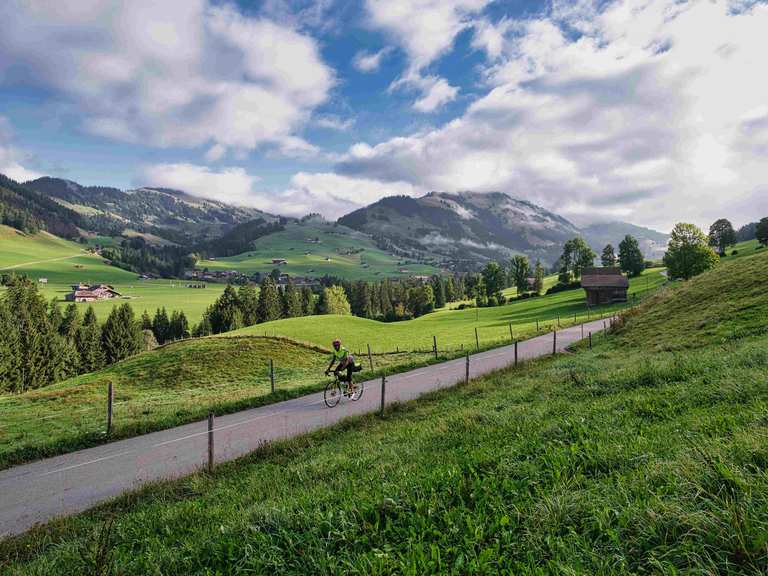
GPS data from Lake Constance to Lake Geneva
You will find the tour data for free download (GPX format) here.
